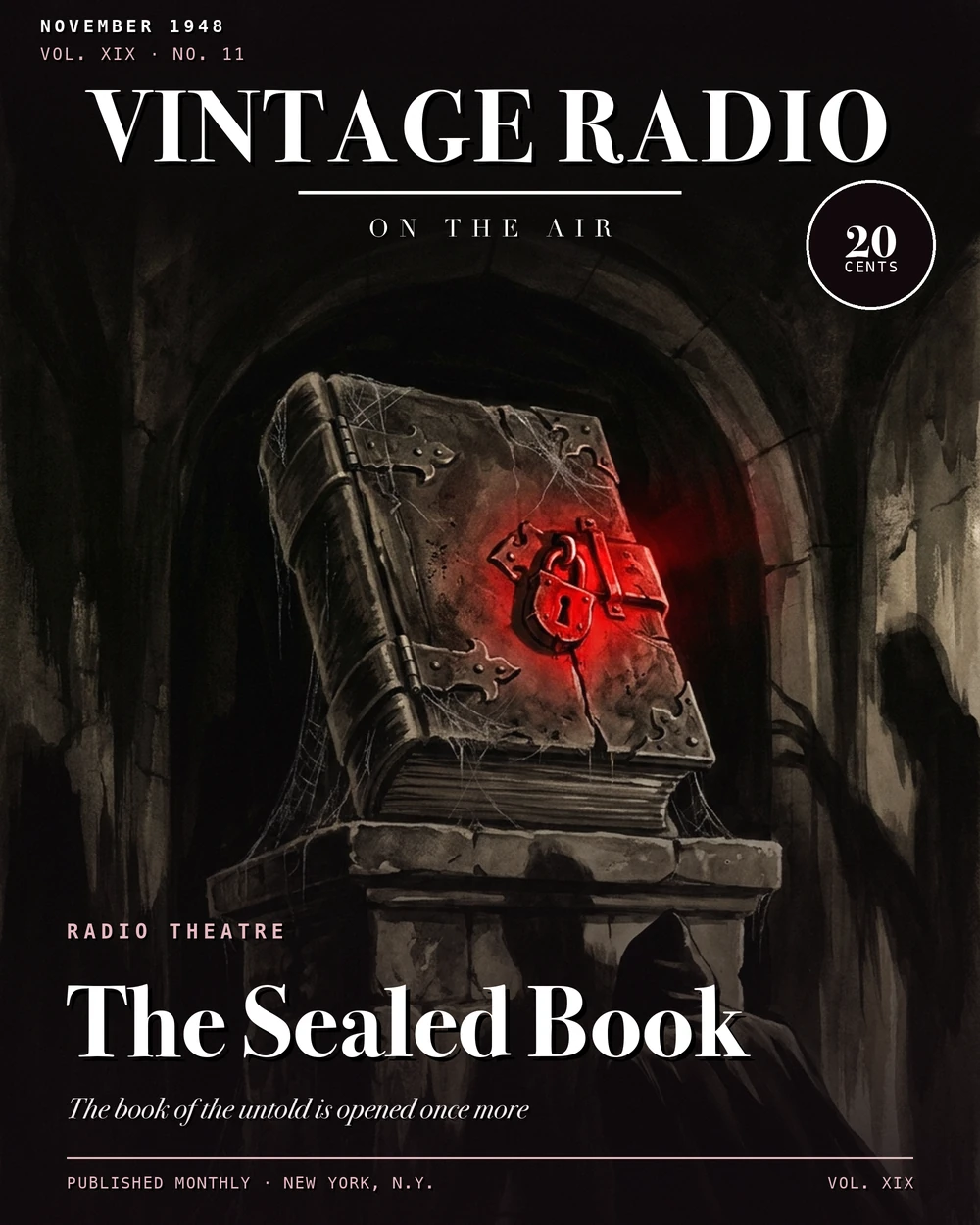
The Sealed Book
Scripts With a Second Life
The Sealed Book ran on the Mutual network for exactly 26 episodes, from March 18 to September 9, 1945, airing Sunday nights at 10:30 in a half-hour format. What made it unusual wasn't the premise — a croaking hermit-type host unlocking forbidden tales each week — but where the stories came from. Writers Robert A. Arthur and David Kogan were recycling the stronger scripts from their other Mutual series, The Mysterious Traveler, adapting them at full length for this companion program. The Sealed Book was essentially a second run for material that had already proven itself, which gave a short-lived show a surprisingly solid foundation.
That parent series, The Mysterious Traveler, had debuted on Mutual on December 5, 1943, and would run until September 16, 1952, sponsored by Adam Hats. Arthur and Kogan were industrious enough to spin the same script library in at least two directions simultaneously. A sister series, The Strange Dr. Weird, also on Mutual in 1944–1945 and also directed by Jock MacGregor, used condensed 15-minute versions of the same material, leaning toward supernatural thrillers. The Sealed Book used the full 30-minute adaptations, and by most accounts the murder mystery scripts were preferentially reserved for this longer format.
The practical result of all this recycling turned out to be a small preservation windfall. A number of Mysterious Traveler scripts that were lost from the parent series survived because they had been preserved in their Sealed Book adaptations. What was conceived as a workaday reuse of existing material ended up being the only surviving record of some of those stories.
The Keeper and How He Worked
Each week, the Keeper of the Book — played by Philip Clarke as a cackling, hermit-like figure — unlocked "the great padlock" sealing a mysterious volume said to hold "all the secrets and mysteries of mankind through the ages." From those pages came the week's tale. Philip Clarke's voice was the atmospheric glue holding the conceit together.
There's a wrinkle in how the character developed across the run, though. In the earliest episodes, the Keeper was silent. Michael Fitzmaurice, the series' announcer and narrator, would describe the Keeper turning the pages and announce the episode title, but the character himself didn't speak. Clarke's spoken Keeper was introduced later in the run, which means the show's most distinctive element — that cackling, croaking voice — wasn't there at the start.
Fitzmaurice was a Chicago-born radio actor, born April 28, 1908, working on Mutual and other networks through the 1940s. He was also hosting Mutual's Quiz of Two Cities at the time, and would later play Superman on ABC's The Adventures of Superman in 1950. His role on The Sealed Book was to set the mood and hand off to Clarke's character — a small part structurally, but the first voice listeners heard each Sunday night.
How It Was Put Together
Jock MacGregor handled both production and direction, making him responsible for essentially all the show's technical and creative execution. The Sealed Book was produced as a transcription series — episodes were pre-recorded rather than broadcast live, then distributed for syndicated airing at local affiliate stations. That format came with a built-in structural quirk: each episode contained three organ-solo breaks, designed to give local stations a place to insert their own commercials.
Those organ solos apparently ran long enough to draw listener comment, with the "curiously extended organ solos" becoming a minor talking point about the show. It's the kind of production artifact that tends to stick in the memory of anyone who sat through an episode — a reminder that the transcription format involved real logistical accommodations that shaped what a show actually sounded like from week to week.
The supporting cast across episodes included Maurice Tarplin, Ed Latimer, Alfred Shirley, Bryna Raeburn, Elspeth Eric, and Tony Barrett. Because the anthology format meant no recurring dramatic characters beyond the Keeper and the narrator, the same actors turned up playing entirely different roles from episode to episode. The writers also had a habit of reusing character names across unrelated stories — "Roger" appeared most frequently, with "Hester," "Drake," and "Chris" showing up regularly as well.
The Stories Week to Week
The episode titles give a reliable sense of the show's register. The first broadcast, on March 18, 1945, was titled "The Hands That Killed." From there the run moved through "Death Spins a Web," "Devil Island," "I'll Die Laughing," "The Ghost Makers," "The Man With the Stolen Face," and "Murder Must Be Paid For," among others. The final episode aired September 9, 1945, though sources don't quite agree on what it was called — some list it as "You Only Die Once" and others as "Death Laughs Last."
A full episode list was published in a program guide by Karl Schadow accompanying a commercial CD release of 16 episodes, which remains the primary physical retail collection for the series. The series was certified as complete on October 4, 2010 — all extant episodes collected and verified, spanning two CDs. The 26-episode run amounts to roughly 12 hours and 43 minutes of audio in total.
Arthur and Kogan After the Microphone
Robert A. Arthur was born November 10, 1909, on Corregidor Island in the Philippines, where his father was serving as a U.S. Army lieutenant. He earned a B.A. in English and an M.A. in Journalism from the University of Michigan before making his way into radio writing. His partnership with David Kogan produced sustained work across multiple mystery anthology series throughout the 1940s and into the 1950s.
The pair collected three Edgar Awards from the Mystery Writers of America for their radio work: Best Radio Drama in 1950 for Murder by Experts, an outstanding achievement award in producing, directing, and writing radio mystery shows in 1951, and Best Radio Drama in 1953 for The Mysterious Traveler. The Sealed Book was one of several series Arthur worked on in this period, alongside Dark Destiny, Adventure Into Fear, The Teller of Tales, and Mystery Time. After radio wound down, Arthur moved to Hollywood in 1959 and wrote scripts for The Twilight Zone and Alfred Hitchcock Presents, and ghost-edited a long run of Alfred Hitchcock fiction anthologies for Random House. He died on May 2, 1969, in Philadelphia.
The Keeper himself has been noted by commentators as sharing a structural resemblance with the Crypt Keeper of EC Comics' Tales from the Crypt — both sardonic horror-host narrators presiding over anthology tales of doom. No documented direct influence between the two has been established, but the parallel is close enough that it gets mentioned whenever the show comes up in discussions of the horror-host tradition in American popular culture.